
Department of Health and Human Services, through National Institutes of Health, awarded Cellfe, Inc of Alameda, CA $1,052,108 under the SBIR program (Phase II), with work starting 2026-09-18 and running to 2028-08-31. It is one of 2 SBIR and STTR awards Cellfe, Inc received in the last two years, $1,366,108 in all. Each figure links to the federal record.
The award
| Recipient | Cellfe, Inc (Alameda, CA) |
|---|---|
| Awarding agency | Department of Health and Human Services |
| Awarding office | National Institutes of Health |
| Phase | Phase II |
| Amount obligated | $1,052,108 |
| Period of performance starts | 2026-09-18 |
| Period of performance ends | 2028-08-31 |
| Award number | R44CA310250 (grant, CFDA 93.395) |
| Assistance listing | 93.395, Cancer Treatment Research |
| Place of performance | San Carlos, San Mateo County, CA |
| Signed | 2026-09-17 |
| Recipient registry id (UEI) | M34JNT47EKK3 |
Want the whole picture on Cellfe, Inc?
Example from a real report (our sample on Target): “In March 2026, Target announced a planned incremental $1 billion operating investment” Source: Target Corporation (press release)
A Full Report on Cellfe, Inc: verified, sourced, every claim cited, ready in a few minutes. See pricing.
What the Full Report on Cellfe, Inc covers
The Short Answer
Which Company This Is
What They Do, And How The Money Works
Who Runs It, And How To Reach Them
The Money: Funding, Valuation, Runway
Who Pays Them, And Who They Are Up Against
Warning Bells
Sources
2 cited sources found
Plus the sections for what you are deciding, which you pick after ordering.
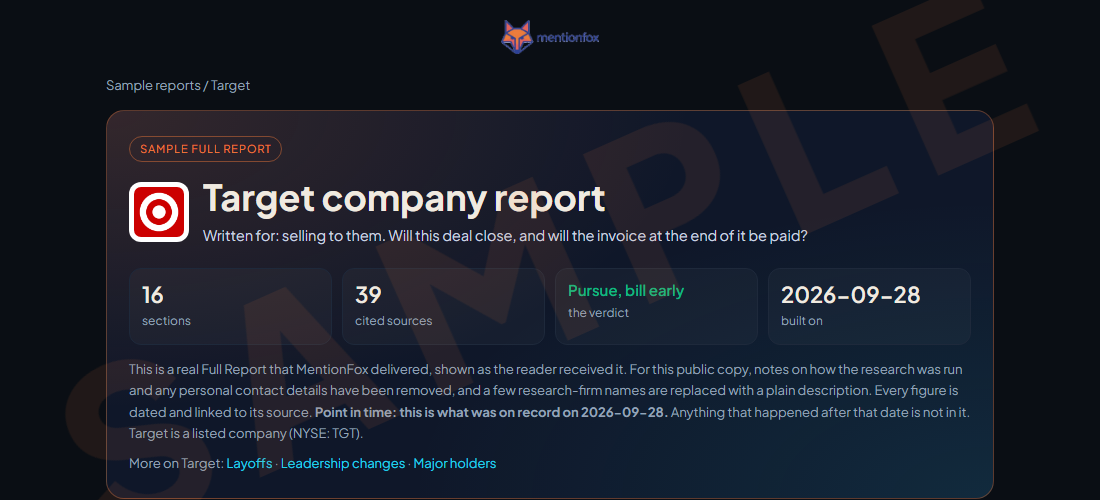 A real finished report, first screen. Opens in a new tab.
What it is for
High throughput, high efficiency, rapid mechanical transfection for car t-cell therapeutics - project summary genetic modification of patient blood cells in the laboratory (“ex vivo”) has been transformational in treatme
Funding actions on this award
| Date | Action | Modification | Amount |
|---|---|---|---|
| 2026-09-17 | New | 000 | $1,052,108 |
High throughput, high efficiency, rapid mechanical transfection for car t-cell therapeutics - project summary genetic modification of patient blood cells in the laboratory (“ex vivo”) has been transformational in treatment of blood malignancies, most notably through the use of engineering t-cells (car-t or tcr t-cells) to recognize and attack blood cancer cells. Despite considerable investment and clinical success with this technology, manufacturing of genetically modified t-cell therapies remains costly and inefficient. Innovative cell processing technologies are needed to increase the scale and reliability of introducing DNA into patient t-cells to serve this growing market and facilitate wider access to t-cell therapies. The mission of cellfe is to simplify manufacturing of life-saving ex vivo gene therapies using our unique, rapid, and efficient “vect” microfluidic technology to deliver gene-modifying cargo to a patient’s cells. The goal of this Phase II SBIR project is to optimize and scale up the vect system for continuous-flow, mechanical manipulation of t-cells to deliver DNA and crispr protein complexes for non-viral genetic editing. This process will allow knock-in of the cancer-targeting car gene and simultaneous knock-out of unwanted immune receptors, such as the t-cell receptor. The four specific aims of this project are: Aim 1) optimize vect for crispr/CAS9 knock- ...
From the federal award record.
Other SBIR and STTR awards to Cellfe, Inc
| Starts | Agency | Program | Amount | Project |
|---|---|---|---|---|
| 2025-09-01 | Department of Health and Human Services | SBIR Phase I | $314,000 | Accelerated, scalable same-day microfluidic sequential gene editing for allogeneic cell th (record) |
Who runs it, who owns it, where the money comes from and what to watch for, every claim linked to its source.
Order Full Report on Cellfe, IncLook up Cellfe, Inc and see what is on record before you decide.
Get the free SnapshotWhere this comes from
The Small Business Innovation Research (SBIR) and Small Business Technology Transfer (STTR) programs set aside part of federal research budgets for small companies. Agencies award them in phases: Phase I tests whether an idea is feasible, Phase II funds development, and Phase III is follow-on work paid for outside the set-aside. STTR awards also require a research institution as a partner.
Every figure on this page is taken from the award's own federal record, linked beside it, as it stood when the page was built: the recipient, its address, the awarding agency and office, the amount obligated so far, the dates and the description. Phase and program are shown as the award's own description states them. The amount can grow later if the agency adds funding to the same award.