
Department of Health and Human Services, through National Institutes of Health, awarded Electronic Biosciences, Inc. of San Diego, CA $386,452 under the SBIR program (Phase I), with work starting 2025-04-01 and running to 2027-03-31. It is one of 3 SBIR and STTR awards Electronic Biosciences, Inc. received in the last two years, $1,119,934 in all. Each figure links to the federal record.
The award
| Recipient | Electronic Biosciences, Inc. (San Diego, CA) |
|---|---|
| Awarding agency | Department of Health and Human Services |
| Awarding office | National Institutes of Health |
| Phase | Phase I |
| Amount obligated | $386,452 |
| Period of performance starts | 2025-04-01 |
| Period of performance ends | 2027-03-31 |
| Award number | R43DA063260 (grant, CFDA 93.279) |
| Assistance listing | 93.279, Drug Use and Addiction Research Programs |
| Signed | 2025-03-19 |
| Recipient registry id (UEI) | FLHHE89XH2H5 |
Want the whole picture on Electronic Biosciences, Inc.?
Example from a real report (our sample on Target): “In March 2026, Target announced a planned incremental $1 billion operating investment” Source: Target Corporation (press release)
A Full Report on Electronic Biosciences, Inc.: verified, sourced, every claim cited, ready in a few minutes. See pricing.
What the Full Report on Electronic Biosciences, Inc. covers
The Short Answer
Which Company This Is
What They Do, And How The Money Works
Who Runs It, And How To Reach Them
The Money: Funding, Valuation, Runway
Who Pays Them, And Who They Are Up Against
Warning Bells
Sources
33 cited sources found
Plus the sections for what you are deciding, which you pick after ordering.
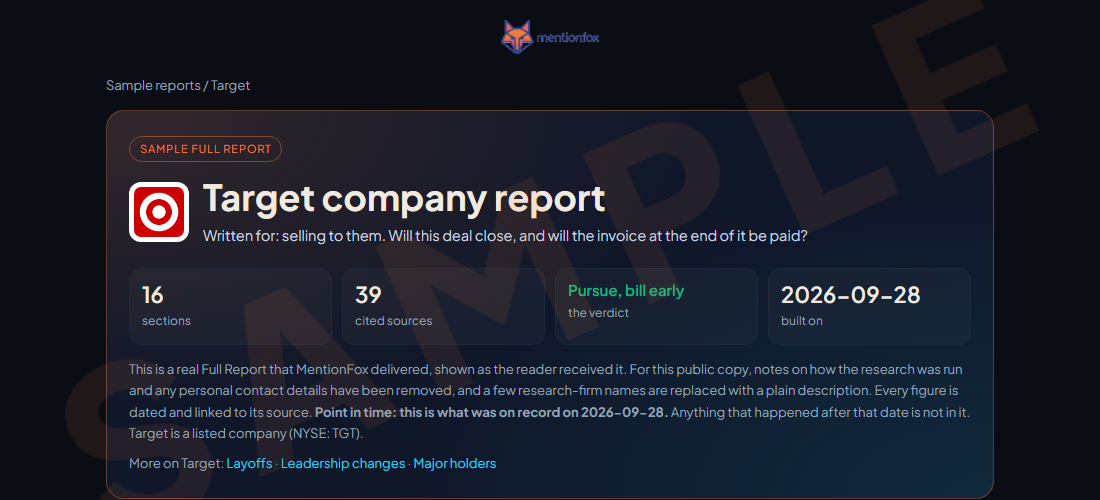 A real finished report, first screen. Opens in a new tab.
What it is for
Rapid fingerstick diagnostics for opioid and stimulant use disorders - project summary opioid and stimulant use disorders (oud/stud) represent an escalating public health crisis in the united states, with more than 107,0
Funding actions on this award
| Date | Action | Modification | Amount |
|---|---|---|---|
| 2026-01-06 | Revision | 000 | $0 |
| 2025-03-19 | New | 000 | $386,452 |
Rapid fingerstick diagnostics for opioid and stimulant use disorders - project summary opioid and stimulant use disorders (oud/stud) represent an escalating public health crisis in the united states, with more than 107,000 overdose deaths reported in 2022, driven predominantly by synthetic opioids (e.g., fentanyl) and increasing use of stimulants like methamphetamine and cocaine. Despite available treatments, <10% of individuals with substance use disorders receive the care they need. Existing diagnostic methods, which rely on urine and blood tests, are hindered by logistical constraints (specialized facilities, multiple sample collections, laboratory processing, and delayed results). Moreover, they do not simultaneously assess for the presence of all opioids, stimulants, and their metabolites, nor do they screen for related critical health indicators such as pregnancy, cardiac injury, cardiovascular stress, inflammation, bacterial infections, clot formation, and neuronal and brain injury. These barriers impede timely intervention and effective monitoring of patients, particularly in underserved and remote areas. The development of an innovative, rapid, and comprehensive diagnostic tool is urgently needed to bridge this gap. Such a tool would enable early detection and continuous monitoring of oud/stud, facilitating timely medical interventions that could significantly reduce t ...
From the federal award record.
Other SBIR and STTR awards to Electronic Biosciences, Inc.
| Starts | Agency | Program | Amount | Project |
|---|---|---|---|---|
| 2025-06-06 | Department of Health and Human Services | SBIR Phase I | $383,482 | Spinseq - project summary RNA sequencing technologies are crucial for understanding gene e (record) |
| 2025-06-01 | Department of Health and Human Services | STTR Phase I | $350,000 | High-resolution pseudouridine and M6A sequencing through advanced nanopore adduct analysis (record) |
Every other federal award to Electronic Biosciences, Inc. on record
The federal register lists 42 or more other awards to the same registry id (UEI FLHHE89XH2H5), $46,459,264 in all, from 6 agencies.
| Starts | Agency | Amount | Award |
|---|---|---|---|
| 2026-09-15 | National Institutes of Health | $466,291 | Enabling protein sequencing through friction-mediated nanopore transport - project summary proteins are active (R21GM165253) |
| 2026-09-09 | Departmental Offices | $2,999,975 | Unified nanopore platform for simultaneous DNA, RNA, and protein sequencing (140D0426C0135) |
| 2026-09-01 | National Institutes of Health | $472,706 | High-fidelity nanopore sequencing of cgg repeats and methylation in the FMR1 gene - project summary fragile x (R21HD121871) |
| 2026-06-08 | National Institutes of Health | $418,854 | Next-generation oncoproteomic sequencing and precision profiling - project summary proteins are the essential (R21CA304932) |
| 2024-09-20 | National Institutes of Health | $400,000 | Next-generation cardiovascular risk assessments via state-of-the-art lipoprotein characterization - project su (R43HL174365) |
| 2024-09-16 | National Institutes of Health | $389,535 | Topic 455: Ideal at-home prostate specific antigen (psa) testing (75N91024C00077) |
| 2024-09-01 | National Institutes of Health | $400,000 | Fourth-generation nanopore-assisted sequencing for advanced oncological analyses - project summary nanopore-ba (R43CA295247) |
| 2023-09-20 | National Institutes of Health | $407,291 | Nanopores for processing proteins - project summary the ultimate goal in the field of proteomics is single-mol (R43HG012961) |
| 2023-09-18 | National Institutes of Health | $400,000 | Microsatellite instability sequencing via single-molecule DNA re-reading - project summary oncologists have a (R43CA287759) |
| 2023-07-01 | National Institutes of Health | $469,799 | Controlled protein translocation in nanopores for sequencing applications - project summary the ultimate goal (R21GM148844) |
| 2023-02-13 | National Institutes of Health | $400,000 | Sequencing the mono-methylated derivatives of cytidine - project summary the goal of this project is to develo (R43HG012850) |
| 2022-08-01 | National Institutes of Health | $393,558 | Dual reader protein sequencing - project summary as IT stands today, traditional/standard protein characteriza (R43HG012559) |
| 2022-07-20 | National Institutes of Health | $393,972 | Two readers for RNA - project summary nanopore-based technology has the potential to be the future of comprehe (R43HG012364) |
| 2022-07-01 | National Institutes of Health | $2,000,000 | Nanoscale tools for inosine sequencing - project summary during this program, electronic biosciences (ebs) wil (R44HG012409) |
| 2022-04-12 | National Institutes of Health | $400,000 | Exonuclease based microsatellite sequencing - project summary electronic biosciences (ebs) will investigate an (R43CA268242) |
| 2022-03-01 | National Institutes of Health | $400,000 | Comprehensive botulinum characterization via the bilayer nanowell integrated assay - project summary during th (R43NS127702) |
| 2021-09-01 | National Institutes of Health | $399,999 | Long-lived platform development for exonuclease-based sequencing - project summary during this project, electr (R41HG012163) |
| 2021-07-01 | National Institutes of Health | $400,000 | Fingerprinting cancer via multiparameter extracellular vesicle analysis - project summary electronic bioscienc (R41CA265607) |
| 2021-06-09 | National Institute of Standards and Technology | $52,000 | Ac + dc temperature controlled system with test cell (1333ND21PNB680254) |
| 2020-08-20 | National Institute of Standards and Technology | $50,255 | Low noise amplifier (1333ND20PNB680682) |
| 2020-05-15 | National Institutes of Health | $400,000 | N6-METHYL-2'-o-methyladenosine sequencing (R43CA243757) |
| 2018-09-17 | National Institutes of Health | $299,999 | Alternating-seq (moonshot) (75N91018C00033) |
| 2018-09-01 | National Institutes of Health | $2,058,141 | Exonuclease epigenetic sequencing (R44HG010049) |
| 2018-08-06 | National Institutes of Health | $642,585 | Microsatellite sequencing to enable cancer genotyping (R21CA228948) |
| 2017-09-18 | National Institutes of Health | $248,077 | Nanoscale tools for RNA modification sequencing (HHSN261201700025C) |
| 2017-09-01 | Department of the Army | $497,566 | Ion current rectification biosensing biomedical technologies (W81XWH1710582) |
| 2015-04-15 | National Institutes of Health | $436,646 | Optimizing nanopore protein interactions (R21EB019232) |
| 2015-03-01 | National Institutes of Health | $1,462,664 | The bilayer nanopore integrated assay for complete toxin characterization, Phase II (R44NS092475) |
| 2013-08-19 | National Institute of Standards and Technology | $14,500 | Upgrade of systems 1&2 (DOCSB134113SU0909) |
| 2011-09-15 | National Institutes of Health | $800,329 | Nanopatch system for next generation ion channel recordings (R44GM093521) |
Who runs it, who owns it, where the money comes from and what to watch for, every claim linked to its source.
Order Full Report on Electronic Biosciences, Inc.Look up Electronic Biosciences, Inc. first. Finding the company and seeing how much is on record uses no credits.
Look up Electronic Biosciences, Inc.Where this comes from
The Small Business Innovation Research (SBIR) and Small Business Technology Transfer (STTR) programs set aside part of federal research budgets for small companies. Agencies award them in phases: Phase I tests whether an idea is feasible, Phase II funds development, and Phase III is follow-on work paid for outside the set-aside. STTR awards also require a research institution as a partner.
Every figure on this page is taken from the award's own federal record, linked beside it, as it stood when the page was built: the recipient, its address, the awarding agency and office, the amount obligated so far, the dates and the description. Phase and program are shown as the award's own description states them. The amount can grow later if the agency adds funding to the same award.