
Department of Health and Human Services, through National Institutes of Health, awarded Corvion, Inc. of Webster, TX $2,086,049 under the SBIR program (Phase II), with work starting 2025-03-01 and running to 2028-02-29. It is one of 2 SBIR and STTR awards Corvion, Inc. received in the last two years, $3,586,033 in all. Each figure links to the federal record.
The award
| Recipient | Corvion, Inc. (Webster, TX) |
|---|---|
| Awarding agency | Department of Health and Human Services |
| Awarding office | National Institutes of Health |
| Phase | Phase II |
| Amount obligated | $2,086,049 |
| Period of performance starts | 2025-03-01 |
| Period of performance ends | 2028-02-29 |
| Award number | R44HL177945 (grant, CFDA 93.837) |
| Assistance listing | 93.837, Cardiovascular Diseases Research |
| Place of performance | Webster, Harris County, TX |
| Signed | 2025-02-21 |
| Recipient registry id (UEI) | DP46YALMA9E8 |
Want the whole picture on Corvion, Inc.?
Example from a real report (our sample on Target): “In March 2026, Target announced a planned incremental $1 billion operating investment” Source: Target Corporation (press release)
A Full Report on Corvion, Inc.: verified, sourced, every claim cited, ready in a few minutes. See pricing.
What the Full Report on Corvion, Inc. covers
The Short Answer
Which Company This Is
What They Do, And How The Money Works
Who Runs It, And How To Reach Them
The Money: Funding, Valuation, Runway
Who Pays Them, And Who They Are Up Against
Warning Bells
Sources
2 cited sources found
Plus the sections for what you are deciding, which you pick after ordering.
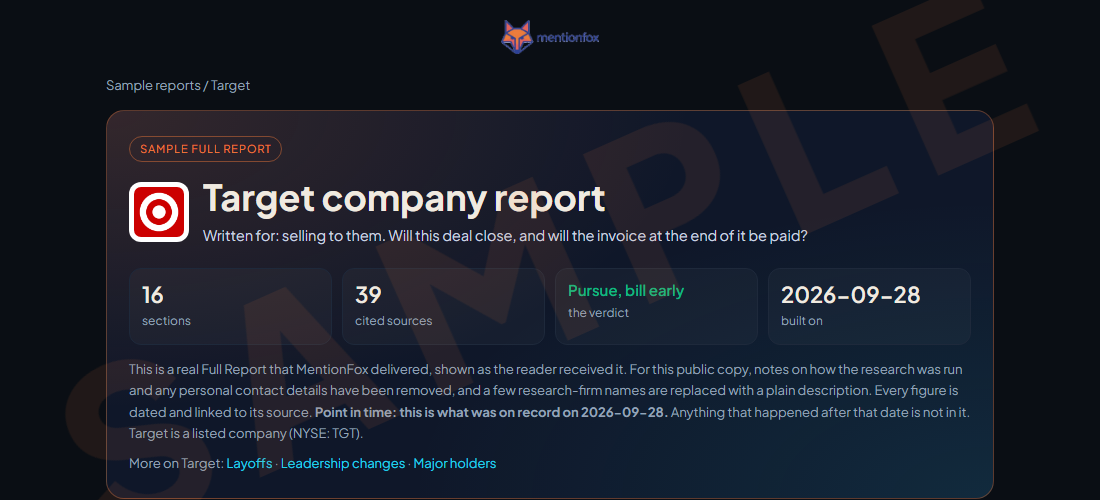 A real finished report, first screen. Opens in a new tab.
What it is for
Development of a totally implanted left ventricular assist device - project summary/abstract in the united states (US) ~6.5 million people have heart failure (hf), there are ~1 million new cases each year, and ~250,000 p
Funding actions on this award
| Date | Action | Modification | Amount |
|---|---|---|---|
| 2026-05-11 | Continuation | 000 | $1,061,414 |
| 2025-02-21 | New | 000 | $1,024,635 |
Development of a totally implanted left ventricular assist device - project summary/abstract in the united states (US) ~6.5 million people have heart failure (hf), there are ~1 million new cases each year, and ~250,000 patients die of heart failure each year. While a heart transplant is the standard treatment, the limited supply of donor organs severely limits this option. A left ventricular assist device (lvad) is currently an accepted treatment option for hf patients, however, only ~2-3% of the over 100,000 potential lvad recipients choose an lvad each year in the US because of the serious complications and poor quality of life. The percutaneous driveline (permanent skin puncture) and continuously worn external batteries powering the high- power consumption blood pump (~8 w) are major causes of complications and poor quality of life. Complications experienced by lvad recipients include infection, stroke, bleeding, and pump thrombosis. Infection is a major concern, with up to 44% of lvad recipients developing an infection. Quality of life restrictions include limited physical activity, inability to submerse in water, and continuously worn external lvad equipment. Our objective is to develop a totally-implanted left ventricular assist device (ti-lvad) achieving reduced complications and enhanced patient quality of life to encourage more patients to adopt an lvad as a bridge-to- ...
From the federal award record.
Other SBIR and STTR awards to Corvion, Inc.
| Starts | Agency | Program | Amount | Project |
|---|---|---|---|---|
| 2026-08-10 | Department of Health and Human Services | SBIR Phase II | $1,499,984 | Development of a novel pediatric lvad for home discharge of children awaiting heart transp (record) |
Who runs it, who owns it, where the money comes from and what to watch for, every claim linked to its source.
Order Full Report on Corvion, Inc.Look up Corvion, Inc. and see what is on record before you decide.
Get the free SnapshotWhere this comes from
The Small Business Innovation Research (SBIR) and Small Business Technology Transfer (STTR) programs set aside part of federal research budgets for small companies. Agencies award them in phases: Phase I tests whether an idea is feasible, Phase II funds development, and Phase III is follow-on work paid for outside the set-aside. STTR awards also require a research institution as a partner.
Every figure on this page is taken from the award's own federal record, linked beside it, as it stood when the page was built: the recipient, its address, the awarding agency and office, the amount obligated so far, the dates and the description. Phase and program are shown as the award's own description states them. The amount can grow later if the agency adds funding to the same award.