
National Science Foundation awarded Anta Biotechnologies Corporation of San Diego, CA $1,229,393 under the SBIR program (Phase II), with work starting 2025-09-15 and running to 2027-08-31. It is one of 2 SBIR and STTR awards Anta Biotechnologies Corporation received in the last two years, $1,403,892 in all. Each figure links to the federal record.
The award
| Recipient | Anta Biotechnologies Corporation (San Diego, CA) |
|---|---|
| Awarding agency | National Science Foundation |
| Phase | Phase II |
| Amount obligated | $1,229,393 |
| Period of performance starts | 2025-09-15 |
| Period of performance ends | 2027-08-31 |
| Award number | 2533096 (grant, CFDA 47.084) |
| Assistance listing | 47.084, Technology, Innovation, and Partnerships |
| Place of performance | San Diego, San Diego County, CA |
| Signed | 2025-09-04 |
| Recipient registry id (UEI) | U1B4HRNRXEM9 |
Want the whole picture on Anta Biotechnologies Corporation?
Example from a real report (our sample on Target): “The Q2 2026 earnings report, published August 19, 2026, showed adjusted EPS of $2.46 against an expected $2.33” Source: CNBC
A Full Report on Anta Biotechnologies Corporation: verified, sourced, every claim cited, ready in a few minutes. See pricing.
What the Full Report on Anta Biotechnologies Corporation covers
The Short Answer
Which Company This Is
What They Do, And How The Money Works
Who Runs It, And How To Reach Them
The Money: Funding, Valuation, Runway
Who Pays Them, And Who They Are Up Against
Warning Bells
Sources
2 cited sources found
Plus the sections for what you are deciding, which you pick after ordering.
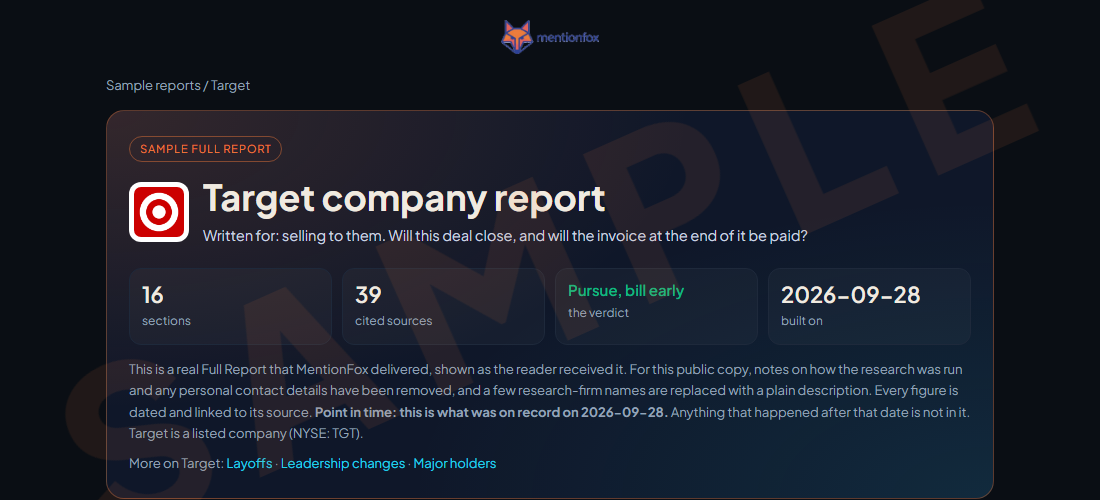 A real finished report, first screen. Opens in a new tab.
What it is for
Autonomous system for DNA sequencing prep in space and austere environments
Funding actions on this award
| Date | Action | Modification | Amount |
|---|---|---|---|
| 2025-09-04 | New | 000 | $1,229,393 |
SBIR Phase II: Autonomous system for DNA sequencing prep in space and austere environments -the broader impact/commercial potential of this small business innovation research (SBIR) Phase II project is to build an automated, miniaturized, gravity-agnostic system for DNA extraction and preparation for sequencing in austere environments. DNA sequencing is used for a variety of purposes in research and medicine ? For example, diagnosis and treatment of diseases; monitoring of pathogens in water supplies and food; and to study the effects of various stressors on humans, crops, and even pets. The global DNA sequencing market size of $11B in 2022 is expected to grow to over $50B by 2032 indicating potential for growth and expansion of DNA sequencing technologies into untapped markets. This project is disrupting the market by developing a portable, automated system for extracting DNA from a variety of biosamples. Small academic and start-up labs and those focused on space research will be early market targets. This project expects to generate nearly $20M in revenue by year three of production. This small business innovation research (SBIR) Phase II project proposes to take a unique approach to technology development ? By building the technology for space and microgravity, the most extreme environment. Currently, there are no commercial automated, miniaturized technology exists for use ...
From the federal award record.
Other SBIR and STTR awards to Anta Biotechnologies Corporation
| Starts | Agency | Program | Amount | Project |
|---|---|---|---|---|
| 2025-09-29 | National Aeronautics and Space Administration | SBIR | $174,499 | 1AUTOMATED DNA extraction in space (record) |
Who runs it, who owns it, where the money comes from and what to watch for, every claim linked to its source.
Order Full Report on Anta Biotechnologies CorporationLook up Anta Biotechnologies Corporation and see what is on record before you decide.
Get the free SnapshotWhere this comes from
The Small Business Innovation Research (SBIR) and Small Business Technology Transfer (STTR) programs set aside part of federal research budgets for small companies. Agencies award them in phases: Phase I tests whether an idea is feasible, Phase II funds development, and Phase III is follow-on work paid for outside the set-aside. STTR awards also require a research institution as a partner.
Every figure on this page is taken from the award's own federal record, linked beside it, as it stood when the page was built: the recipient, its address, the awarding agency and office, the amount obligated so far, the dates and the description. Phase and program are shown as the award's own description states them. The amount can grow later if the agency adds funding to the same award.